Everything in the universe can be measured using the seven fundamental SI units, or their derivatives. All other units of measurement can be reduced down to these seven units, which create a consistent framework for all of science. Each unit corresponds to a specific physical property:
- meter (m) – length
- kilogram (kg) – mass
- second (s) – time
- ampere (A) – electric current
- kelvin (K) – temperature
- mole (mol) – amount of substance
- candela (cd) – luminous intensity
Knowing that our universe in its entirety can be represented using only these units begs some curiosity over what the largest and smallest values of these units are in our universe. To use length as an example, the largest measurable thing is the universe itself, at around 9 × 1026 meters in diameter. That’s 9, followed by 26 zeros, or 900,000,000,000,000,000,000,000,000 meters. The smallest measurable thing in our universe is a particle called an upsilon meson. It has a diameter of roughly one femtometer, or 10-16 (0.000,000,000,000,001) meters. An upsilon meson is composed of a bottom quark and an anti-bottom quark, and will require a small lesson on the Standard Model to explain.
A Small Lesson on the Standard Model
It is common knowledge that everything that we can touch is made up of atoms, which are made up of protons, neutrons, and electrons. In the late 20th century, it was discovered that protons and neutrons can be broken down into smaller components, called quarks. Quarks are one of the many elementary particles in our universe. These elementary particles are arranged as the Standard Model, which groups them into quarks, leptons, and bosons. We don’t interact with the majority of these particles; the important ones to our reality are the up and down quarks, the electron, and the photon. Protons are made up of 2 up quarks and 1 down quark, while neutrons are composed of 2 down quarks and 1 up quark.
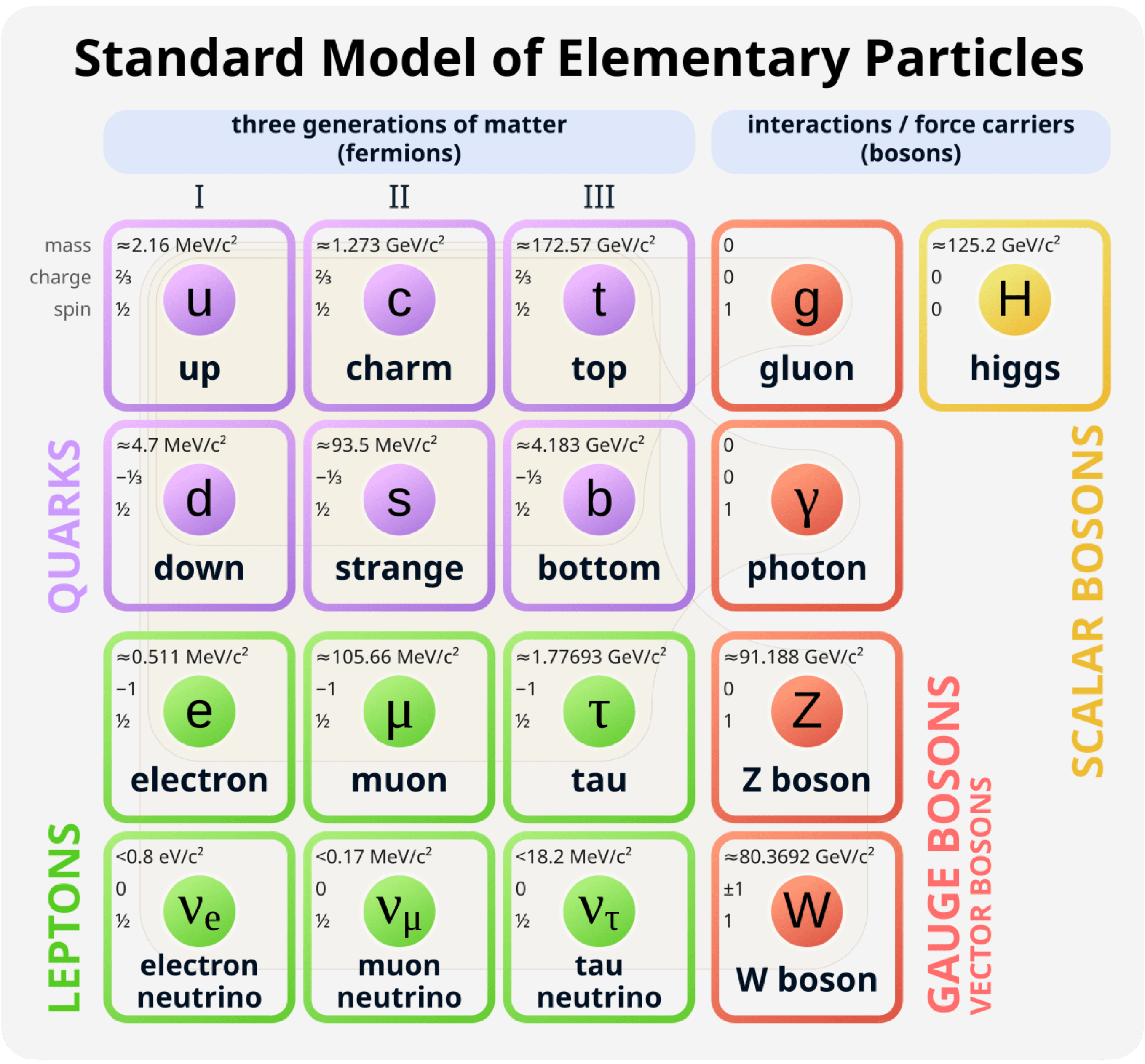
You may notice that the particle I said to be the smallest in the universe, the upsilon meson, is not in the Standard Model. As it turns out, the elementary particles found in the Standard Model don’t have any measurable shape or size. They are effectively zero-dimensional. The concept of length only arises through composite particles, ie. combining two or more of these elementary particles together to form new particles such as protons or neutrons. When initially researching this, it appeared that protons were the smallest measurable thing in our universe, but that conclusion seemed flawed, since protons were made up of 3 quarks. What about a particle made up of 2 quarks?
2-quark particles can exist in the form of mesons. You may have heard of antimatter, which is made of particles which have opposite charge, but are equal in all other regards to the normal particles that make up nearly all of our universe. 2-quark mesons are made up of one quark and one anti-quark. So as it turns out, the smallest measurable thing in our universe is a 2-quark meson called an upsilon meson. The reason we don’t ever hear about upsilon mesons, or any other composite particles aside from protons or neutrons is because they are incredibly unstable. An upsilon meson has a mean lifetime of around 10-20 seconds before decaying, whereas the decay of a proton has never been observed (meaning they may be the only perfectly stable particle. While neutrons within the nucleus of an atom are completely stable as well, outside of a nucleus, neutrons have a lifetime of only 15 minutes before they decay into a proton, electron, and anti-neutrino).
Back on Track – Length
So now knowing what the largest and smallest items are, how do humans stack up? Where have we been placed in the universe, on the scale of length? This can be easily shown with a logarithmic scale.

We’re about 38% of the way across. I’m not sure why this information is so satisfying, but it’s cool to know where we sit. How do we fare on the scale of mass?
Mass
The mass of the universe has been calculated to be approximately 1053 kg. The smallest mass that we know of is the electron neutrino, which you can find in the Standard Model we looked at earlier. It has a mass of 10-37 kg. Similarly to our conversation about the smallest measurable thing in the universe by length, there are particles which have zero mass, like the photon, but for the same reasons we didn’t use photons or electrons (zero length particles) as our length limit, we won’t use photons or other bosons (zero mass particles) as our mass limit. Between the mass of electron neutrinos and the universe, we’re slightly closer to the neutrinos, at 43% of the way across.

Time
The universe has been around for 13.8 billion years, which is 4 × 10¹⁷ seconds. The smallest amount of time could be described as the smallest process which can occur, according to our other limits. In this case it would be the time it takes for a photon travelling at the speed of light to cross our smallest distance: the diameter of an upsilon meson. This is around 3 zeptoseconds, or 3 × 10-24 seconds. The human value for time is more difficult than for length or mass. It’s not as clear what value should be used. I’ll include three different values in the scale, so you can decide which one is most important to you.

The first is one second, which corresponds to one human heartbeat. That’s 58% of the way across. Next is one day (86,400 seconds), since we structure our lives around daily cycles. That’s 70%. The final one is the average human lifespan of 73 years, which is 81% of the way across. If I got to choose one of these units to experience the largest amount of, I would pick time. I think it’s beautiful that we’re so far across this scale.
Electric Current
The research for this scale has been problematic. For starters, it’s much less intuitive, since (if we’re lucky) most of us never have a memorable quantitative experience with electric current, but maybe we could use the value of current in our brains (10-12 A), or in our nerves/muscles (10-3 to 10-6 A). The largest ampere value ever recorded was 1018 A, from a cosmic jet two billion light years away. This value is fine, but it was recorded in 2011, and there have probably been larger currents in the past and there will probably be larger currents in the future, so it’s not a very consistent or meaningful value, unlike what we have for other units.
The other issue is that the lower bound is not clear at all. Electric current measures charge (electrons) per second. Compared to other units, this is arbitrary, useful only to humans because biological systems and the systems they create often require electricity. Maybe the lowest bound could be one electron per second, but then why not decrease that to one electron per minute, and so on? Unfortunately, this unit doesn’t make much sense to address.
Temperature
Temperature is an interesting unit because the lower bound is a little foggy as well. Technically, there is a hard lower bound of 0 kelvin, but the laws of thermodynamics and quantum mechanics make it impossible for anything to reach 0 K. This is good news for us because a value of 0 would not compute in our logarithmic scale. Throughout the entire universe, space itself is bathed in 2.725 K radiation from the Big Bang, so nothing naturally cools below that without external intervention.
That’s not quite the minimum though, because sometimes there is external intervention. The coldest naturally occurring temperature is found in the Boomerang Nebula, which is expanding extremely fast, causing adiabatic cooling (similar to how expanding gas in a spray can gets cold). It reaches around 1 K.
This, however, is still not the lowest bound. Humans have accomplished something truly incredible. In 2021, scientists achieved a temperature of 38 picokelvin (3.8 × 10⁻¹¹ K). This means that as far as we know, humans have created the coldest temperatures in the entire history of the universe - by eleven orders of magnitude. The only thing that could beat us is an alien civilization with even more advanced cooling tech. That’s pretty cool.
For the sake of this discussion, we’ll use the naturally occurring 1 K of the boomerang nebula as our lowest value, since the man-made value is constantly undergoing new records and is less meaningful in the context of the universe. The highest temperature the universe has ever experienced was shortly after its inception, when it reached 1032 K. This temperature is so high that our laws of physics break down for anything hotter than this. At 310 K, humans are only 8% of the way across this scale.

Amount of Substance
This scale is pretty similar to the one for mass, since generally, the more particles you have, the more massive you are, but let’s check it out anyways. Amount of substance is measured in moles, which is defined as 6.022 × 10²³ items. We’ll use atoms as our items. The logical lower bound is 1 atom, which is 1 divided by Avogadro’s constant, which comes out to 1.7 × 10⁻²⁴ moles. A typical human has around 11,600 moles of atoms, and the universe is estimated to have roughly 1056 moles of atoms. Humans are 35% of the way across this scale.

The reason that this scale does not align perfectly with the mass scale is because the average atomic mass of the atoms in a human body is much higher than the average atomic mass of the atoms in the universe. Most of the universe is made up of hydrogen (~92% of all atoms), which has an atomic mass of just 1 u. Helium makes up most of the rest, at 4 u. These are the lightest elements, so the universe’s average atomic mass is skewed very low—around 1.3 u per atom.
Compare that to the human body, which is mostly oxygen, carbon, hydrogen, nitrogen, calcium, and phosphorus. While hydrogen is still present, it’s vastly outnumbered by oxygen (16 u), carbon (12 u), and the other heavier elements. The average atomic mass of a human body is closer to 12 u per atom.
Luminous Intensity
Candela is another one of those units that is very human-centric. Unlike total power output (which would be measured in watts), the brightness measured by candelas accounts for how the human eye perceives different wavelengths of light. Similarly to the ampere, candelas measure something per second, so the lower bound for this unit is unclear, because while we could choose one photon per second, we could also choose one photon per minute, or per hour, etc.
To make matters worse, the upper bound is just as unclear. Determining luminous intensity requires precise knowledge of the angular distribution of light, which has so far not been possible for the brightest items in our universe, such as supernovae and quasars. They’re too far away for us to conduct an analysis of their light like this.
Final Thoughts
All of this information is up for your own interpretation. There’s beauty to it all, and gives lots of room for deep thoughts. How would life be different if we were at different places in each of these scales? How do different scales affect each other? Why is our position in each of these scales such perfect sweet spots? If aliens existed out there, could they exist in vastly different places within the scales?
I hope you enjoyed learning about all this as much as I did!